A masked hero who kisses the ground she walks on
I love heroes in masks. So I looked back to the originals.
In the month of April, I was in the mood for old school swashbucklers. I read Isabel Allende’s ZORRO and Baroness Emma Orczy’s THE SCARLET PIMPERNEL. The Scarlet Pimpernel and Zorro are some of the first masked vigilantes in popular culture, inspiring many that came after them. There'd be no hunky billionaire Bruce Wayne without the himbo fop of Percy Blakeney.
I kept thinking of Allende’s ZORRO as a Batman Begins-treatment of the famous hero. The novel begins before the titular hero is born and ends right as he is becoming his famous version. I expected Allende’s work to subvert the typical Zorro tale. Even with that expectation, I was surprised with how important women were in shaping Diego De La Vega into a hero. His mother, Toypurnia, is based on an actual medicine woman of the Tongva tribe, and she is his first model for being a sword fighter and crusader for justice. When receiving his education in Europe, Diego learns magic tricks and acrobatics from his connection with a Romani widow, who becomes his lover. As he reaches the end of his teens, sisters Juliana and Isabel are always at his side. Juliana is the object of his affection but Isabel suits up and fights alongside him. It is only near the end of the book that he re-encounters Lolita, a childhood friend, who will be his eventual love interest in The Curse of Capistrano—the first Zorro book, which I quote in my superhero romance Saint of the Shadows.
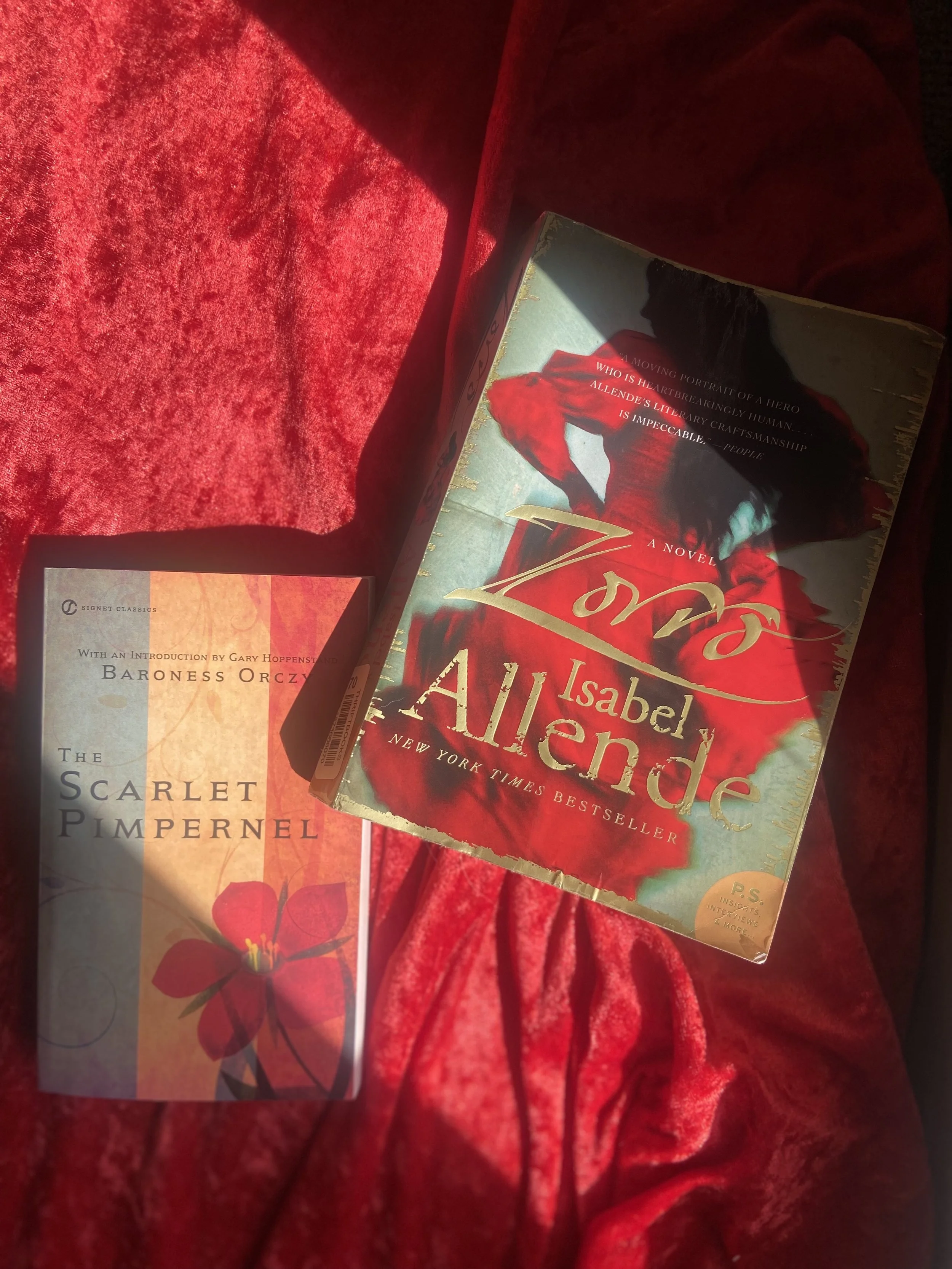
Isabel Allende’s Zorro and Emma Orczy’s The Scarlet Pimpernel
The original masked heroes
I was expecting a more typical swashbuckler in The Scarlet Pimpernel because of its influence on Zorro and Batman. What I didn't expect was that the actual protagonist is Percy's wife, Marguerite, and that her bravery is what keeps her husband out of the clutches of his nemesis, Chauvelin. I am an utter sucker for descriptions of Percy himself—his tall and fit build demonstrating his capacity for heroics—and his devotion to Marguerite, at one point kissing the stairs and the balustrade that she walks on and touches. They are now some of my Kindle highlights.
I was shocked that the concept of a masked superhero started in a place of love and romance. I initially thought my Saint of the Shadows was a subversion of the superhero genre by focusing on Marisol, the nurse in love with the masked vigilante. But in a way, I am returning the masked hero to its roots—a man shaped into crusading for justice by the women who love him. In my Shadowhaven series, it's two men. And some of Percy's worship of Marguerite will feel very familiar to readers who've met the Patron Saint and his alter ego(s).